

Melting and Boiling Points
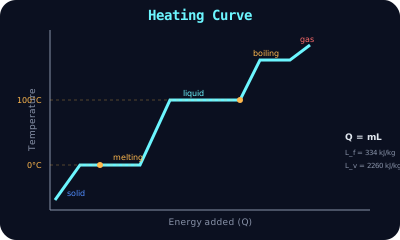
Learning Objectives
- Students will be able to define melting point and boiling point
- Students will be able to explain how intermolecular forces affect melting and boiling points
- Students will be able to predict relative melting/boiling points based on molecular structure
Core Concepts
- melting_point
- boiling_point
- intermolecular_forces
- latent_heat_of_fusion
- latent_heat_of_vaporization
- normal_boiling_point
Formulas
$$Q_{fusion} = m L_f$$
Heat required to melt a substance
$$Q_{vap} = m L_v$$
Heat required to vaporize a substance
Units
| latent heat of fusion | L_f (J/kg) |
| latent heat of vaporization | L_v (J/kg) |
Interesting Fact
Some substances have extremely high melting points: tungsten melts at 3422°C and is used in light bulb filaments
Key Scientist
Gabriel Daniel Fahrenheit
Determined boiling and melting points and created the Fahrenheit scale
Philosophy
Melting and boiling points are physical properties that depend on the intermolecular forces and molecular structure of a substance. These properties can provide information about the behavior and characteristics of different materials, but do not define the fundamental 'nature' or 'inherent limits and boundaries' of a substance.
Want to truly master this? Try the interactive lesson!
Start Lesson