

Second Law of Thermodynamics and Entropy
Learning Objectives
- Students will be able to explain entropy as a measure of disorder at the molecular level
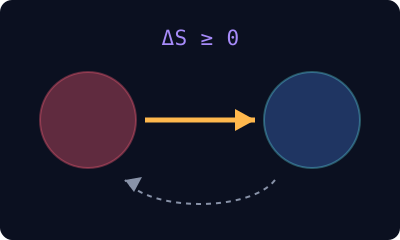
- Students will be able to state and apply the Second Law of Thermodynamics
- Students will be able to calculate entropy changes and theoretical efficiency of heat engines
Core Concepts
- entropy
- disorder
- heat_engine
- carnot_efficiency
- irreversible_process
- spontaneous_process
Formulas
$$\Delta S = \frac{Q_{rev}}{T}$$
Entropy change for reversible process
$$\Delta S_{universe} > 0$$
Second Law: entropy of isolated system always increases
$$\eta = 1 - \frac{T_C}{T_H}$$
Maximum efficiency of heat engine (Carnot efficiency)
$$S = k \ln W$$
Boltzmann's definition of entropy (microscopic perspective)
Units
| entropy | S (J/K) |
| boltzmann constant | k = 1.38×10⁻²³ J/K |
Interesting Fact
Black holes have entropy associated with their event horizons, suggesting entropy is fundamental to the universe
Key Scientist
Nicolas Léonard Sadi Carnot
Developed the Carnot cycle and limits on heat engine efficiency
Modern Research
The Second Law of Thermodynamics places limits on the efficiency of certain types of machines, such as heat engines. Understanding the concept of entropy is crucial for developing sustainable energy solutions and addressing global warming.
Want to truly master this? Try the interactive lesson!
Start Lesson