

Buoyancy and Archimedes' Principle
Learning Objectives
- Students will understand Archimedes' principle and buoyant force
- Students will calculate whether objects float or sink
- Students will apply buoyancy to real-world situations
Core Concepts
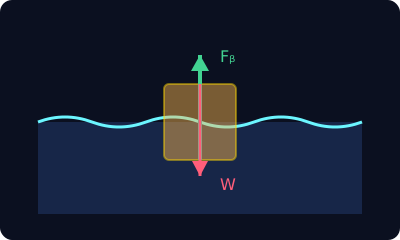
- Buoyant force: upward force from displaced fluid
- Archimedes' principle: F_b = ρ_fluid × V_displaced × g
- Objects float when buoyant force equals weight
Formulas
$$F_b = \rho_{fluid} V_{displaced} g$$
Buoyant force equals fluid density times displaced volume times g
$$F_b = W_{displaced}$$
Buoyant force equals weight of displaced fluid
$$\rho_{object} < \rho_{fluid}$$
Floating condition based on density
Interesting Fact
Submarines control buoyancy by filling/emptying water ballast tanks
Key Scientist
Archimedes
Discovered that buoyant force equals weight of displaced fluid
Modern Research
Understanding buoyancy is essential for submarines, floating structures, and ocean engineering; computational fluid dynamics relies on these principles.
Want to truly master this? Try the interactive lesson!
Start Lesson