

Radioactivity
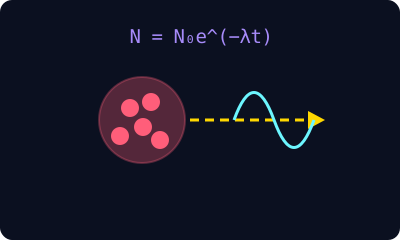
Learning Objectives
- Students will be able to identify and describe alpha, beta, and gamma decay
- Students will be able to calculate half-life and decay constants
- Students will be able to write and balance nuclear equations
Core Concepts
- Alpha decay
- Beta decay
- Gamma radiation
- Half-life
Formulas
$$N = N_0 \left(\frac{1}{2}\right)^{t/T_{1/2}}$$
Number of nuclei remaining after time t
$$A = \lambda N$$
Activity (decay rate) equals decay constant times number of nuclei
$$T_{1/2} = \frac{\ln 2}{\lambda}$$
Half-life in terms of decay constant
Units
| Becquerel | Bq |
| Curie | Ci |
Interesting Fact
Alpha particles are helium-4 nuclei: two protons and two neutrons
Key Scientist
Ernest Rutherford
Studied radioactive decay and identified alpha and beta radiation
Ancient Wisdom
Radioactive transformation reflects spiritual concepts of impermanence and change; radioactive materials were historically associated with mystical transmutation.
Want to truly master this? Try the interactive lesson!
Start Lesson