

Derived Units
Learning Objectives
- Students will understand how derived units are formed from base units
- Students will be able to identify common derived units (newton, joule, watt, pascal, hertz)
- Students will write derived units in terms of base units
Core Concepts
- Derived units are combinations of base units
- Common derived units: newton (N), joule (J), watt (W), pascal (Pa), hertz (Hz)
- Dimensional analysis with derived units
Formulas
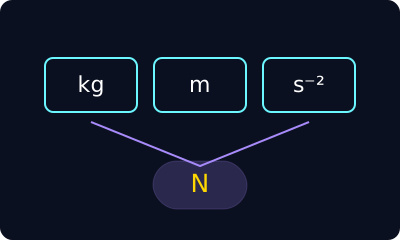
$$\text{N} = \text{kg} \cdot \text{m/s}^2$$
Newton is the unit of force
$$\text{J} = \text{kg} \cdot \text{m}^2\text{/s}^2$$
Joule is the unit of work and energy
$$\text{W} = \text{J/s} = \text{kg} \cdot \text{m}^2\text{/s}^3$$
Watt is the unit of power
$$\text{Pa} = \text{N/m}^2 = \frac{\text{kg}}{\text{m} \cdot \text{s}^2}$$
Pascal is the unit of pressure
$$\text{Hz} = \frac{1}{\text{s}} = \text{s}^{-1}$$
Hertz is the unit of frequency
Units
| newton | N |
| joule | J |
| watt | W |
| pascal | Pa |
| hertz | Hz |
Interesting Fact
The watt is named after James Watt, the engineer who improved the steam engine
Key Scientist
Isaac Newton
Newton's second law (F=ma) defines the newton unit of force
Philosophy
Derived units represent abstract physical concepts (such as force, energy, and power) that are created through logical combinations of base measurements. This shows how scientific theories and models structure our understanding of the physical world. Derived units help us quantify and describe complex phenomena that cannot be directly measured, revealing the underlying connections between different physical quantities.
Want to truly master this? Try the interactive lesson!
Start Lesson