

Lenses and Image Formation
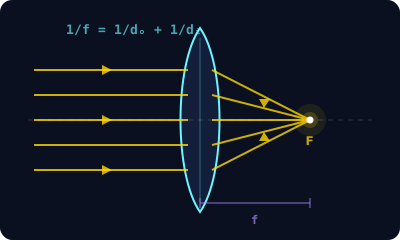
Learning Objectives
- Students will be able to explain image formation in converging and diverging lenses
- Students will be able to apply the thin lens equation and magnification formula
- Students will be able to construct ray diagrams for lens images
- Students will be able to relate lens properties to focal length and refractive index
Core Concepts
- converging_lens
- diverging_lens
- focal_point
- focal_length
- thin_lens_equation
- magnification
- virtual_image
- real_image
Formulas
$$\frac{1}{f} = \frac{1}{d_o} + \frac{1}{d_i}$$
Thin lens equation (f is focal length, d_o is object distance, d_i is image distance)
$$\frac{1}{f} = (n-1)\left(\frac{1}{R_1} - \frac{1}{R_2}\right)$$
Lensmaker's equation (n is refractive index, R are radii of curvature)
$$m = -\frac{d_i}{d_o}$$
Magnification (negative for inverted images)
Interesting Fact
The human eye is essentially a converging lens focusing light on the retina
Key Scientist
Isaac Newton
Studied chromatic aberration and lens properties
Ancient Wisdom
The lens as a tool for gathering light and focusing it parallels meditation practices that gather and focus the mind's attention.
Want to truly master this? Try the interactive lesson!
Start Lesson