

Ohm's Law
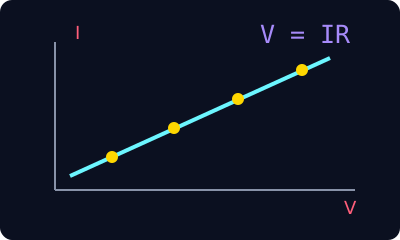
Learning Objectives
- Students will be able to apply Ohm's Law to solve circuit problems
- Students will be able to analyze I-V characteristics of components
- Students will be able to predict how circuits respond to changing voltage or resistance
Core Concepts
- V = IR relationship
- I-V characteristics
- Ohmic and non-ohmic behavior
Formulas
$$V = IR$$
Ohm's Law relating voltage, current, and resistance
$$I = \frac{V}{R}$$
Alternative form solving for current
$$R = \frac{V}{I}$$
Alternative form solving for resistance
Units
| Volt | V |
| Ampere | A |
| Ohm | Ω |
Interesting Fact
Ohm's Law is one of the most important relationships in electronics
Key Scientist
Georg Simon Ohm
Experimentally determined the relationship V = IR
Ancient Wisdom
The balance between voltage and resistance mirrors the concept of equilibrium and harmony found in traditional Chinese philosophy and Eastern spirituality.
Want to truly master this? Try the interactive lesson!
Start Lesson