

Electric Motors
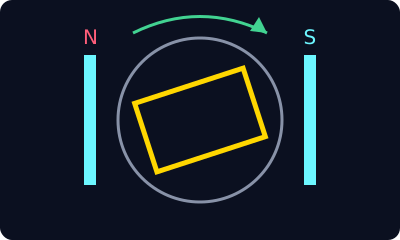
Learning Objectives
- Students will be able to explain how motors convert electrical energy to mechanical energy
- Students will be able to apply Fleming's left-hand rule to predict motor motion
- Students will be able to understand the role of commutators in DC motors
Core Concepts
- Motor force
- Fleming's left-hand rule
- Commutator action
Formulas
$$F = BIL\sin\theta$$
Force on a current-carrying conductor in a magnetic field
$$\tau = NBIA\sin\theta$$
Torque on a motor coil with N turns
Units
| Newton | N |
| Newton-meter (torque) | N·m |
Interesting Fact
The rotating coil must change connections (commutator) to maintain rotation in one direction
Key Scientist
John Ambrose Fleming
Developed Fleming's left-hand rule for determining motor force direction
Ancient Wisdom
Motors embody the principle of sacred geometry and balanced forces — three perpendicular axes representing the structure of reality.
Want to truly master this? Try the interactive lesson!
Start Lesson