

Density
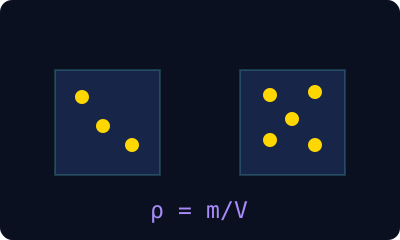
Learning Objectives
- Students will be able to define density and calculate it using the formula ρ = m/V
- Students will be able to predict whether objects will float or sink based on relative densities
- Students will be able to explain how density varies with temperature and pressure
Core Concepts
- mass
- volume
- density
- buoyancy
- relative_density
Formulas
$$\rho = \frac{m}{V}$$
Density equals mass divided by volume
$$W = \rho V g$$
The weight of a substance in a gravitational field
Units
| kilogram per cubic meter | kg/m³ |
| gram per cubic centimeter | g/cm³ |
Interesting Fact
A teaspoon of neutron star material would weigh about 6 billion tons due to its extreme density
Key Scientist
Archimedes
Discovered the principle of buoyancy (Archimedes' Principle)
Philosophy
Density reveals how the same volume can contain vastly different amounts of substance; it embodies the philosophical principle that appearance can mask underlying reality.
Want to truly master this? Try the interactive lesson!
Start Lesson