

Conservation of Energy
Learning Objectives
- Students will understand energy conservation in mechanical systems
- Students will calculate energy transformations between potential and kinetic
- Students will apply conservation of energy to solve problems
Core Concepts
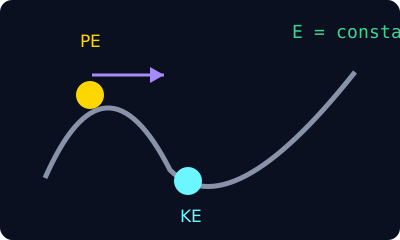
- Total mechanical energy: E = KE + PE
- In absence of non-conservative forces: E_initial = E_final
- Energy transforms but total is conserved
Formulas
$$E_{total} = KE + PE = \frac{1}{2}mv^2 + mgh$$
Total mechanical energy (constant if no friction)
$$E_i = E_f$$
Conservation of energy in isolated system
$$KE_i + PE_i = KE_f + PE_f$$
Energy conversion between kinetic and potential
Interesting Fact
Energy conservation is one of the most fundamental laws of physics
Key Scientist
Julius Robert von Mayer
Established the law of conservation of energy
Ancient Wisdom
The principle of conservation of energy is a fundamental law of physics stating that the total energy of an isolated system remains constant, it is neither created nor destroyed but merely transformed or transferred from one form to another. This physical law does not directly mirror or connect to Eastern philosophy's principle of universal interconnection and transformation.
Want to truly master this? Try the interactive lesson!
Start Lesson