

Friction
Learning Objectives
- Students will distinguish between static and kinetic friction
- Students will understand factors affecting friction
- Students will calculate friction forces and their effects
Core Concepts
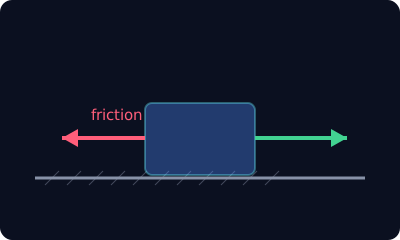
- Static friction: prevents objects from starting to move
- Kinetic friction: opposes motion of moving objects
- Friction depends on normal force and material properties
Formulas
$$f_s \leq \mu_s N$$
Maximum static friction equals coefficient times normal force
$$f_k = \mu_k N$$
Kinetic friction equals coefficient times normal force
Interesting Fact
The coefficient of friction is dimensionless and typically between 0 and 1
Key Scientist
Charles-Augustin de Coulomb
Developed quantitative theory of friction
Modern Research
Nanotribology studies friction at atomic scales; understanding friction is crucial for MEMS devices and reducing energy loss in machinery.
Want to truly master this? Try the interactive lesson!
Start Lesson