

Impulse and Impulse-Momentum Theorem
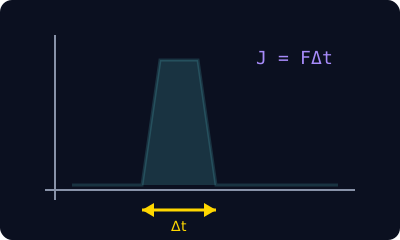
Learning Objectives
- Students will understand impulse as change in momentum
- Students will apply the impulse-momentum theorem
- Students will calculate impulses and momentum changes
Core Concepts
- Impulse: product of force and time interval
- Impulse equals change in momentum
- J = FΔt = Δp relationship
Formulas
$$J = F \Delta t$$
Impulse equals force times time interval
$$J = \Delta p = m(v_f - v_i)$$
Impulse equals change in momentum
$$F_{avg} = \frac{\Delta p}{\Delta t}$$
Average force from momentum change and time
Units
| newton-second | N·s |
Interesting Fact
Catching a ball safely requires understanding impulse and extending impact time
Key Scientist
Isaac Newton
Original formulation of second law involved impulse and momentum
Modern Research
Collision safety engineering uses impulse concepts; airbags extend collision time to reduce peak forces that damage organs.
Want to truly master this? Try the interactive lesson!
Start Lesson