

Work and the Work-Energy Theorem
Learning Objectives
- Students will understand work as transfer of energy
- Students will calculate work done by forces
- Students will apply the work-energy theorem
Core Concepts
- Work: force applied through a distance
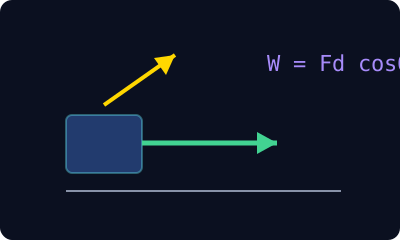
- W = Fd cosθ (depends on angle between force and displacement)
- Work-energy theorem: net work equals change in kinetic energy
Formulas
$$W = Fd \cos\theta$$
Work equals force times distance times cosine of angle
$$W = \Delta KE = \frac{1}{2}m(v_f^2 - v_i^2)$$
Work-energy theorem: work equals change in kinetic energy
Units
| joule | J |
Interesting Fact
The concept of work bridges mechanics and thermodynamics
Key Scientist
James Prescott Joule
Established the relationship between work and heat
Ancient Wisdom
The concept of 'right action' (karma yoga) in Hindu philosophy parallels work: meaningful action requires both will (force) and appropriate direction (displacement).
Want to truly master this? Try the interactive lesson!
Start Lesson