

Mirrors and Image Formation
Learning Objectives
- Students will be able to explain image formation in plane, concave, and convex mirrors
- Students will be able to apply the mirror equation and magnification formula
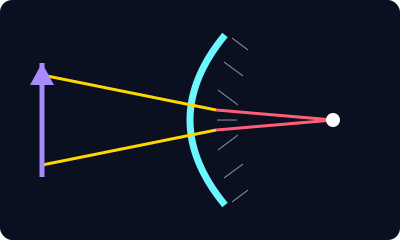
- Students will be able to construct ray diagrams for mirror images
Core Concepts
- plane_mirror
- concave_mirror
- convex_mirror
- focal_point
- center_of_curvature
- magnification
- virtual_image
- real_image
Formulas
$$\frac{1}{f} = \frac{1}{d_o} + \frac{1}{d_i}$$
Mirror equation (f is focal length, d_o is object distance, d_i is image distance)
$$m = -\frac{d_i}{d_o}$$
Magnification of mirror (negative for inverted images)
Interesting Fact
The focal length of a curved mirror is half its radius of curvature: f = R/2
Key Scientist
Alhazen
Early studies of curved mirror behavior
Modern Research
Mirror design is fundamental to telescopes, microscopes, and modern optical instruments; curved mirrors are essential for focusing and magnification.
Want to truly master this? Try the interactive lesson!
Start Lesson