

Refraction of Light
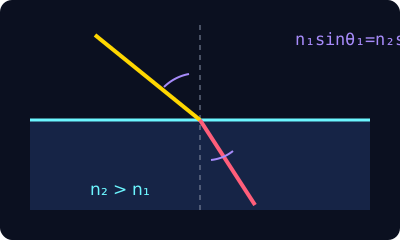
Learning Objectives
- Students will be able to explain refraction as bending of light at media boundaries
- Students will be able to apply Snell's Law to calculate refraction angles
- Students will be able to explain refraction using wave behavior
Core Concepts
- snell_law
- refractive_index
- critical_angle
- total_internal_reflection
- medium_boundary
- light_bending
Formulas
$$n_1 \sin\theta_1 = n_2 \sin\theta_2$$
Snell's Law (n is refractive index, θ is angle from normal)
$$n = \frac{c}{v}$$
Refractive index (c is speed of light in vacuum, v is speed in medium)
$$\theta_c = \arcsin\frac{n_2}{n_1}$$
Critical angle for total internal reflection
Interesting Fact
Diamonds sparkle due to their high refractive index (2.42) and ability to disperse light
Key Scientist
Willebrord Snell
Discovered Snell's Law relating incident and refracted angles
Philosophy
Refraction shows that light's path changes at boundaries; it demonstrates that interfaces between different states create transformation and change in trajectory.
Want to truly master this? Try the interactive lesson!
Start Lesson