

Wave Fundamentals
Learning Objectives
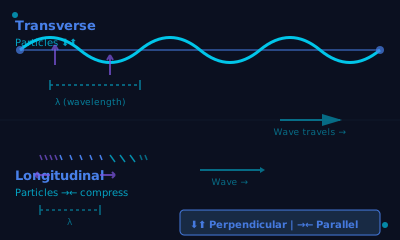
- Students will be able to define waves and distinguish between transverse and longitudinal waves
- Students will be able to describe how waves transfer energy without transferring matter
- Students will be able to identify and classify wave types in different media
Core Concepts
- transverse_wave
- longitudinal_wave
- wave_motion
- energy_transfer
- medium
- particle_motion
Formulas
$$v = \lambda f$$
Wave speed relates wavelength and frequency
Units
| wavelength | λ (meters) |
| frequency | f (hertz, Hz) |
Interesting Fact
Seismic waves from earthquakes can be both P-waves (longitudinal) and S-waves (transverse), allowing geologists to understand Earth's interior
Key Scientist
Christiaan Huygens
Developed wave theory of light as alternative to Newton's particle theory
Philosophy
Waves represent energy and information transfer without matter transport; they embody the principle that influence can spread without substance moving.
Want to truly master this? Try the interactive lesson!
Start Lesson