

Doppler Effect
Learning Objectives
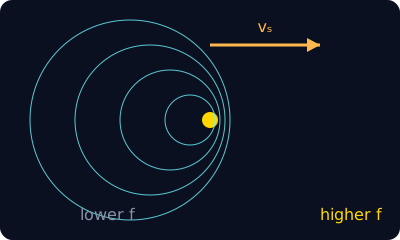
- Students will be able to explain why frequency changes when source or observer moves
- Students will be able to calculate observed frequency using Doppler equations
- Students will be able to apply Doppler effect to real-world situations including radar and astronomy
Core Concepts
- doppler_shift
- relative_motion
- blue_shift
- red_shift
- source_velocity
- observer_velocity
Formulas
$$f' = f \frac{v \pm v_{obs}}{v \mp v_{src}}$$
Doppler formula (+ when approaching, - when receding)
$$\frac{\Delta f}{f} = \frac{v_{rel}}{v}$$
Approximate Doppler shift for velocities much less than wave speed
Interesting Fact
The big bang itself was detected through analysis of the cosmic microwave background, an artifact of Doppler shift on a cosmic scale
Key Scientist
Christian Doppler
Discovered and explained the Doppler effect in 1842
Ancient Wisdom
Movement toward spiritual truth (blue shift) or away from it (red shift) parallels how consciousness changes depending on one's trajectory.
Want to truly master this? Try the interactive lesson!
Start Lesson