

Gas Laws
Learning Objectives
- Students will be able to apply Boyle's Law, Charles's Law, and Gay-Lussac's Law to predict gas behavior
- Students will be able to use the Ideal Gas Law to solve complex gas problems
- Students will be able to explain gas laws in terms of kinetic theory
Core Concepts
- boyle_law
- charles_law
- gay_lussac_law
- ideal_gas_law
- pressure
- volume
- molar_quantity
Formulas
$$PV = \text{const}$$
Boyle's Law
$$\frac{V}{T} = \text{const}$$
Charles's Law
$$\frac{P}{T} = \text{const}$$
Gay-Lussac's Law
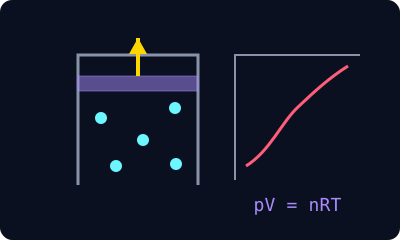
$$PV = nRT$$
Ideal Gas Law (R = 8.314 J/mol·K or 0.0821 L·atm/mol·K)
Units
| pascal | Pa (N/m²) |
| atmosphere | atm |
| mole | mol |
Interesting Fact
The Ideal Gas Law combines Boyle's, Charles's, and Gay-Lussac's Laws into one comprehensive equation
Key Scientist
Joseph Gay-Lussac
Discovered the relationship between pressure and temperature (Gay-Lussac's Law)
Ancient Wisdom
The pursuit of ideality (ideal gas) while accepting real deviation parallels the spiritual path of aspiring to ideals while accepting human limitations.
Want to truly master this? Try the interactive lesson!
Start Lesson